
Proof We Were Here
Is this why we're Filmmakers?

I saw an interesting Substack post this morning about pop-up photo booths. There are several companies in Los Angeles that have set up storefronts with vintage photo booths. The kind you see at weddings, Bar-Mitzvas, my Uncle’s funeral, well, that’s another story altogether. Apparently, there are lines around the block of people to go and take that magic strip of photos that marks an occasion, a first date, or maybe just a fun time out.
I find it kind of quaint, actually. I mean we carry a photo booth around in our pockets all day to record selfies with duck lips, our friends falling over, or other hijinks. But to have an instant printed record of the hijinks holds something more primal for us.
When you think of cave drawings, it’s much the same thing. Stick figures with a herd of buffalo seems like a profound message of the human experience from long, long ago. For all we know, those cave people looked at those etchings in the rock face and just laughed for years around the fire, “remember the time Og put a dead bird on his head and got run over by a bunch of Buffalo? Ha, good times, good times, I miss him, pass the Pterodactyl …. ”
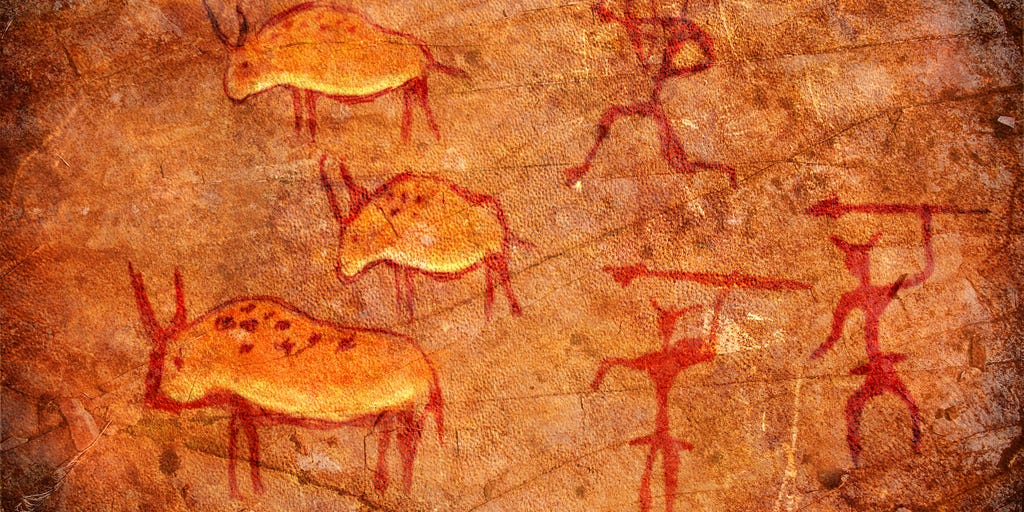
The about page of the photo booth website says we all want “proof we were here.” On an existential level, I think that’s right.
The urge that Filmmakers have to tell a story and record it goes beyond just art. It goes to preserving an idea, a story of the human condition, and the Filmmakers to show for all time “proof they were here.”
It’s the very reason that I always sit through the credits. It’s not that I will know much of anyone whose name appear there, and I really don’t need to know who the catering team was, but it’s a matter of respect. For those in the crawl, it’s the proof they were here. For any of us who are involved in the Filmmaking process, their names are our names. Their cave drawings are our cave drawings.
I think this is why there are such strong feelings about using AI to make Art. Since there have been computers, we’ve used computer programs to assist in making images. We’ve used them for everything from storyboarding to onboard camera settings to the editing and finishing process. Distributing our work is all digital, transported to streaming platforms and movie theaters via vast tracks of ones and zeros.
However, what was once a process of using programs as additive, adjacent tools, are now threatening to become the entire process. I am not a purist by any stretch of the imagination. I believe there is a place for AI in our work, but it can’t be allowed to become our work.
Insisting on a full ban on using AI is not the answer. Refusing to even have discussions about how to use AI in filmmaking is definitely not the answer. To deny the conversation leaves Capitalism to have the entire discussion on its own, and we all know how that will turn out.
We have to find ways to come together as filmmakers and figure out the best way to use AI programs and processes to accentuate how we make movies, and reject those processes that remove us totally from the equation.
For example, if AI to achieve a cost-effective, accurate, and realistic gun discharge had arrived earlier, Cinematographer Helena Hutchin’s son would still have a Mother for the simple reason that there would have been no bullets, blanks or live Ammo at all on the set of “Rust” There would have been no need. The weapon could have been a non-working replica. A $7 million movie would have had the resource to shoot the gunplay scene without tragically shooting anyone.
That is just one example of perhaps myriad ways to make filmmaking better. However, we can’t figure it out unless we come together as the creators to pursue process and parameters. AI is a technical advance; the technicians need to have constant forums to define how to use it. A toothless negotiation by the Unions every three years will do nothing. AI is not going away; it has to be siloed towards the uses where it can be best applied.
Let’s not be fooled by advances such as Tilly Norwood. AI movie stars aren’t really a thing. A bit of a novelty perhaps, but a full-length narrative with an AI star, or all AI actors, is a ways off. Even still, I question the ability of an AI performance to bring the emotional subtly of Rooney Mara in “Carol” or Philip Seymour Hoffman in “The Master.” I’ll laugh every time at a piano falling on Tilly Norwood, but I question that an AI actor will ever get us to feel something deeper, something soulful.
The technology isn’t there in any affordable way to make fully AI movies. But the bits and pieces? They are available and affordable. By using them, we have a chance to define how it’s employed by actual use cases. To avoid the conversation and AI tools will certainly get us run over by a herd of Capitalist Buffalo.
If we want to maintain our legacies and our “proof we were here,” we need to take some control of the process. It’s the only way through. We have to talk about it.